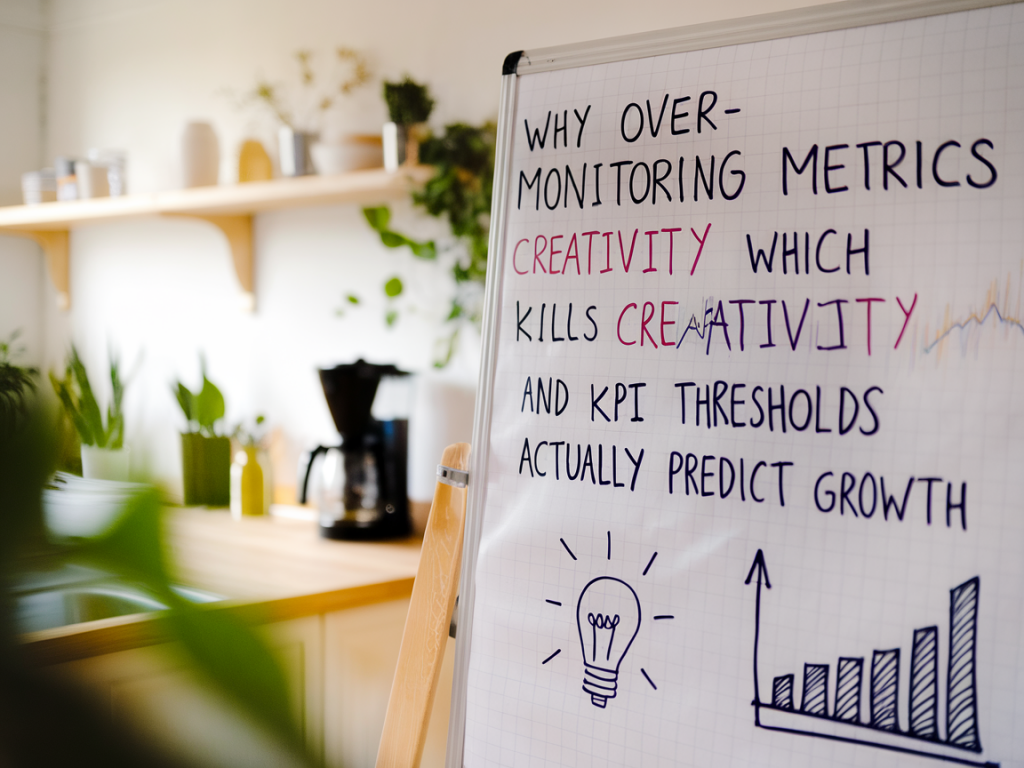
I used to be guilty of it: opening analytics five times a day, refreshing follower counts during a stream, and chasing every tiny uptick in impressions as if that one number would unlock sustainable growth. Over the years working with creators and product teams, I’ve learned that over-monitoring metrics actively undermines creativity. It turns experimentation into second-guessing and forces creators into short-term optimization loops that don’t move the needle long-term.
Why watching everything hurts creative work
There are three simple psychological mechanisms by which over-monitoring smothers creative momentum:
When I coach creators, I tell them: your job is to create, not be a real-time data analyst. Data is a compass, not a leash. The question is which compass points predict growth, and how often you should check it.
Which three KPI thresholds actually predict growth
Not all KPIs are equal. From dozens I track across streamers and small media teams, three stand out as high-signal predictors of sustainable growth. They’re not vanity metrics — they measure retention, conversion, and monetization efficiency. Each has a simple threshold that, when met consistently, correlates strongly with future audience expansion.
Why it matters: Returning viewers are the engine of growth. If people come back, your content is building habit and trust. For live streams and short-form VODs, measure how many unique viewers return to another piece of content within seven days. In my work, creators who consistently hit or exceed a 35% first-week return rate tend to see steady follower gains and higher lifetime value per viewer.
How to measure: Use platform analytics — YouTube’s “Return Viewers” metric, Twitch’s “unique viewers vs repeat viewers”, or a simple CRM list matching viewer IDs within a 7-day window. If you use a multi-platform distribution (Restream, Streamyard), aggregate unique identifiers in a spreadsheet or analytics tool.
What to do if you’re below threshold: Test hooks that encourage return — a consistent schedule, a recurring segment (weekly Q&A or mini-series), or cliffhanger end screens in VODs. Avoid over-optimizing thumbnails every upload; instead, invest in formatting an anchor experience that makes viewers expect your next piece.
Why it matters: Engagement is a behavioral proxy for community energy. It’s not enough to get views — you want viewers who react, comment, share, or subscribe. In live contexts, measure chat messages and unique chatters normalized by concurrent viewers; for VODs, measure comments and likes per 100 viewers. Panels and merch shops are downstream outcomes, but engagement is the upstream indicator.
How to measure: For live, take average concurrent viewers and divide unique chatters by that number, multiplied by 100 to get percent. For VODs, compute (likes + comments + shares) / total views * 100. Tools like StreamElements and Muxy help for live engagement; YouTube Studio gives basic VOD engagement stats.
What to do if you’re below threshold: Switch from monologue to interaction. Add explicit cues (“say X in chat to enter”), use polls, or integrate community prompts in the first 10 minutes of the stream. Again: don’t chase spikes by asking for spammy engagement every minute. Build rituals that produce consistent, meaningful interaction.
Why it matters: Growth without a way to capture and re-engage an audience is fragile. A low-friction sign-up (email, Discord, Patreon trial) creates a durable pathway for distribution off-platform. Across creators I’ve worked with, a steady conversion rate of around 2% from unique reach to a one-time, low-friction commitment reliably predicts sustainable audience monetization and retention.
How to measure: Divide number of new signups by unique viewers/impressions for a given period, then multiply by 100 to get a percent. Use UTM links for cross-platform tracking and confirm via your email provider or Discord invite analytics. If you’re using Linktree or Koji, ensure you can extract real conversion numbers rather than pure click counts.
What to do if you’re below threshold: Reduce friction. Offer a simple value exchange — a single useful resource, early access, or an exclusive emoji for Discord. Move the CTA earlier in the piece and make it actionably simple (one-click or one-field sign-up). Test incentives but prioritize utility; transactional freebies often have lower long-term value.
How to stop over-monitoring without losing control
I don’t mean “ignore data.” I mean set constraints that let you create without daily panic. Here’s a practical monitoring routine I recommend to creators and product teams:
Structuring monitoring like this reduces cognitive load and preserves your creative capacity. It forces you to act on meaningfully aggregated signals, not noise.
Practical tweaks to measure the three KPIs without getting lost
Here are concrete setups I use and recommend:
Tools and mental models I actually use
I’m pragmatic about tooling: OBS or Streamlabs for production, YouTube Studio and Twitch Analytics for base metrics, Plausible or GA4 when I need site-level conversions, and Notion or a Google Sheet for the dashboard. For community captures I prefer Mailchimp or ConvertKit for emails and a Discord server rather than leaky social DMs. The tool doesn’t matter if you keep the signal simple.
One last personal note: some of my best creative pivots came when I ignored short-term metrics for two weeks and focused entirely on format experiments — a serialized story arc in streams, a recurring guest slot, or a new production value level. The data that mattered arrived after I stopped watching the noise and let new habits form. If you can discipline your dashboard checks to the three KPIs above, you’ll find you have more time and creative energy to build the things that actually predict growth.